



In modern manufacturing, speed, precision, and consistency are essential for maintaining productivity and product quality. As production volumes continue to grow, industries are increasingly adopting automation to reduce manual handling and improve process efficiency. One of the most effective solutions for high-volume, repetitive operations is the Rotary Indexing Machine.
A rotary indexing machine is widely used in industries such as automotive, electrical, electronics, medical devices, packaging, and engineering to perform multiple operations on a component in a single production cycle. By combining different processes into one automated system, it helps manufacturers improve accuracy, reduce production time, and increase overall efficiency.
At Aerowheel Surface Finishing, we design and manufacture rotary indexing machines that deliver reliable performance, high precision, and long-term productivity for various industrial applications.
What Is a Rotary Indexing Machine?
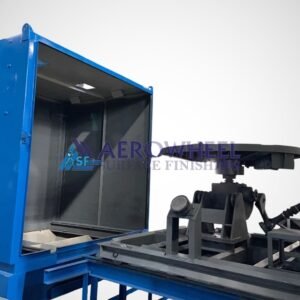
A Rotary Indexing Machine is an automated assembly or processing system that uses a rotating indexing table to move components through a series of workstations. Each station performs a specific operation such as drilling, tapping, pressing, assembly, inspection, marking, or testing.
Instead of manually transferring components between different machines, the rotary table automatically indexes the part from one station to the next, ensuring smooth and continuous production.
This automation reduces cycle time while maintaining consistent quality throughout the manufacturing process.
How Does a Rotary Indexing Machine Work?
The working principle of a rotary indexing machine is simple yet highly efficient.
Step 1: Component Loading
The component is placed onto a fixture mounted on the rotary indexing table. Loading may be done manually or through an automated feeding system depending on production requirements.
Step 2: Indexing Movement
The rotary table rotates by a fixed angle, moving the component to the first workstation.
Each movement is known as an index, ensuring precise positioning at every station.
Step 3: Sequential Operations
As the table continues rotating, different manufacturing operations are performed at each workstation.
Depending on the application, these operations may include:
- Drilling
- Tapping
- Press fitting
- Riveting
- Surface finishing
- Leak testing
- Component assembly
- Laser marking
- Quality inspection
Each operation is completed while other stations work simultaneously on different components.
Step 4: Final Inspection
Before unloading, the finished component may pass through an inspection station where sensors or vision systems verify quality and dimensional accuracy.
Step 5: Finished Component Unloading
Once all operations are complete, the finished component is automatically or manually removed, and the cycle begins again with the next part.
Main Components of a Rotary Indexing Machine
A rotary indexing machine consists of several precision-engineered components that work together for smooth operation.
These typically include:
- Rotary indexing table
- Precision fixtures
- Drive mechanism
- PLC-based control system
- Pneumatic or hydraulic actuators
- Sensors and safety systems
- Operator control panel
- Loading and unloading stations
The combination of these components ensures accurate positioning and reliable production.
Advantages of Rotary Indexing Machines
High Production Speed
Multiple operations are performed simultaneously at different stations, significantly reducing overall cycle time.
This allows manufacturers to produce more components in less time.
Improved Accuracy
Each component is positioned precisely at every workstation, ensuring repeatable manufacturing accuracy and reducing dimensional variations.
Consistent Product Quality
Automation eliminates many of the inconsistencies associated with manual operations.
Airflow Design in Paint Spray Booths – Explained Simply
Cost Breakdown of Setting Up a Sand Blasting Unit in Rajasthan
How to Calibrate Shot Blasting Machines for Consistent Output
Every component follows the same production sequence, resulting in uniform quality.
Reduced Manual Handling
Since components move automatically between stations, manual intervention is minimized.
This reduces operator fatigue and lowers the risk of handling errors.
Higher Productivity
By combining several manufacturing processes into one machine, production becomes faster and more efficient.
This improves equipment utilization and overall plant productivity.
Lower Operating Costs
Although the initial investment may be higher than standalone machines, rotary indexing machines reduce:
- Labour costs
- Production time
- Material handling
- Rework
- Operational waste
These savings contribute to a lower cost per component over the long term.
Common Industrial Applications
Rotary indexing machines are widely used across multiple industries, including:
Automotive Industry
- Component assembly
- Bearing installation
- Brake system components
- Engine parts
Electrical and Electronics
- Switch assembly
- Connector manufacturing
- Terminal pressing
- Circuit component assembly
Medical Device Manufacturing
- Syringe assembly
- Surgical instrument production
- Medical component testing
General Engineering
- Precision machining
- Fastener assembly
- Industrial component manufacturing
Consumer Products
- Packaging components
- Household appliance parts
- Small mechanical assemblies
Why Industries Prefer Rotary Indexing Machines
Manufacturers choose rotary indexing machines because they offer an ideal combination of automation, precision, and productivity.
Key reasons include:
- Faster production cycles
- Consistent product quality
- Better process control
- Compact machine design
- Easy integration with automated production lines
- Reduced dependence on manual labour
These advantages make rotary indexing machines suitable for both medium and high-volume manufacturing.
Choosing the Right Rotary Indexing Machine
Before investing in a rotary indexing machine, manufacturers should consider:
- Type of component being produced
- Number of manufacturing operations
- Required production capacity
- Automation level
- Available floor space
- Future expansion requirements
- Ease of maintenance
- Availability of technical support
Selecting the right machine ensures maximum productivity and long-term return on investment.
Aerowheel Surface Finishing’s Rotary Indexing Solutions
At Aerowheel Surface Finishing, we design rotary indexing machines that are customized according to customer requirements and manufacturing processes.
Our solutions focus on:
- High-precision indexing systems
- Robust industrial construction
- PLC-based automation
- Reliable performance
- Easy maintenance
- Long service life
We work closely with manufacturers to develop solutions that improve productivity while maintaining the highest quality standards.
Final Thoughts
A rotary indexing machine is one of the most efficient automation solutions for manufacturers looking to increase production speed, improve accuracy, and reduce manual operations. By performing multiple processes in a single automated cycle, these machines help industries achieve consistent quality, higher productivity, and lower operating costs.
Whether you manufacture automotive parts, electrical components, medical devices, or precision engineering products, investing in the right rotary indexing machine can significantly improve your production efficiency and long-term business performance.
If you’re looking for reliable and customized rotary indexing solutions, Aerowheel Surface Finishing offers advanced machines designed to meet the demands of modern manufacturing.