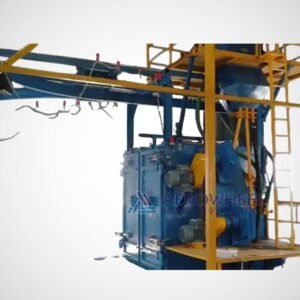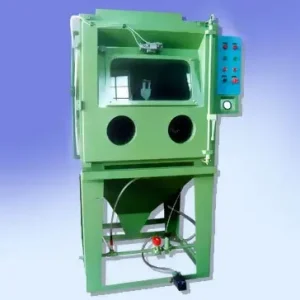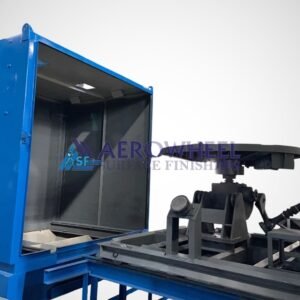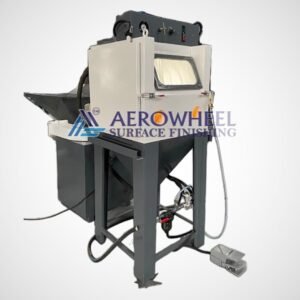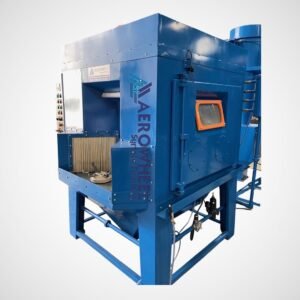




In the surface preparation and finishing industry, both blast rooms and shot peening chambers play vital roles — but they serve different purposes. Understanding their differences is essential for choosing the right system for your production needs.
At Aerowheel Surface Finishing, we design and manufacture both blast room systems and shot peening chambers, each tailored for specific industrial applications. Let’s explore how they differ in function, design, and performance.
1. Purpose and Application
Blast Rooms:
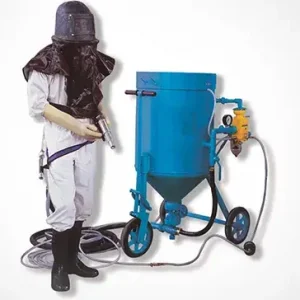
Blast rooms are designed primarily for surface cleaning, paint removal, rust elimination, and surface preparation before coating or welding. They use high-pressure abrasive streams to clean or roughen large components such as machinery parts, vehicles, and structural steel.
Shot Peening Chambers:
Shot peening, on the other hand, is a precision surface treatment process. It involves bombarding the surface with spherical media (shots) to create compressive stress, improving fatigue strength, and preventing cracks or failures. This technique is commonly used in the aerospace, automotive, and defense industries for enhancing component durability.
Key Difference:
- Blast Room: Cleans and prepares the surface.
- Shot Peening Chamber: Strengthens and hardens the surface.
2. Abrasive Media Used
Blast Rooms:
Can use a variety of abrasives — steel grit, aluminum oxide, garnet, or glass beads — depending on the cleaning requirement and material type.
Shot Peening Chambers:
Exclusively use spherical media like cast steel shot, ceramic beads, or glass beads to ensure controlled impact and uniform stress distribution.
Key Difference:
- Blast Rooms: Flexible in abrasive choice.
- Shot Peening Chambers: Strictly use round shots for precision.
3. Process Control and Automation
Blast Rooms:
Often manually controlled, though modern blast rooms may include semi-automatic abrasive recovery and dust collection systems. Operators control nozzle angle, distance, and motion manually.
Shot Peening Chambers:
Operate with highly automated systems that precisely control shot velocity, impact angle, coverage rate, and exposure time. IoT and robotics are commonly integrated for accuracy.
Key Difference:
- Blast Rooms: Operator-driven and flexible.
- Shot Peening Chambers: Fully automated and precision-focused.
4. Surface Finish and Outcome
Blast Rooms:
Deliver a cleaned, textured, and uniform surface ideal for painting, coating, or bonding.
Shot Peening Chambers:
Do not aim for cleaning but for inducing compressive stress and improving mechanical performance. The finish is smoother, with measurable surface hardness.
Common Challenges in Sand Blasting and How to Solve Them
Jodhpur's Airless Edge: Unveiling Your Perfect Tumblast Partner
Industries That Prefer Wet Blast Cabinets
Key Difference:
- Blast Room: Focus on appearance and coating adhesion.
- Shot Peening: Focus on durability and structural integrity.
5. Equipment Design and Construction
Blast Room Systems:
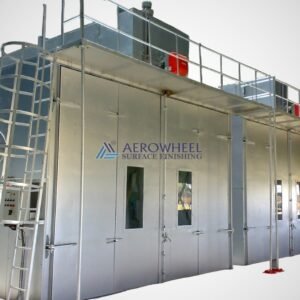
- Large enclosures for manual or semi-automatic blasting.
- Include dust collectors, lighting systems, and abrasive recovery floors.
- Built for versatility and heavy-duty operation.
Shot Peening Chambers:
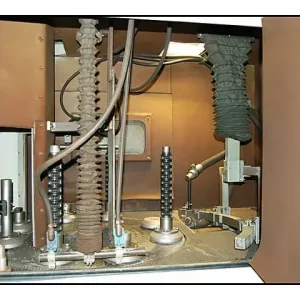
- Compact and enclosed systems with precise control mechanisms.
- Often include rotary tables, robotic arms, or CNC integration for consistent peening results.
Key Difference:
- Blast Rooms: Built for flexibility and scale.
- Shot Peening Chambers: Built for precision and automation.
6. Cost and Maintenance
Blast Rooms:
Have a lower initial setup cost and simpler maintenance routines, making them ideal for general industrial use.
Shot Peening Chambers:
Require a higher investment due to automation, control systems, and calibration tools. Maintenance involves frequent monitoring of shot size, flow, and coverage consistency.
Key Difference:
- Blast Rooms: Cost-effective and versatile.
- Shot Peening Chambers: High-precision but higher cost.
Conclusion
While both systems use abrasive blasting principles, their goals, technologies, and outcomes differ significantly.
- Choose a blast room if your objective is surface cleaning, rust removal, or coating preparation.
- Choose a shot peening chamber if your goal is surface strengthening, stress relief, or fatigue resistance enhancement.
At Aerowheel Surface Finishing, we provide end-to-end solutions for both systems — from design and installation to automation and maintenance. Whether you need a custom-built blast room or a precision-controlled shot peening setup, we deliver technology that ensures performance, reliability, and compliance with international standards.